Or so it would seem.
In truth, the White House’s latest tariff play quietly includes concessions that will allow a handful of recognizable Canadian brands to remain on American shelves. We’ve spent the past few days scrutinizing the annex, an exhaustive list that spans beer, wine, cider, spirits, Scotch and Irish whisky, bourbon, rye whisky, rum, vodka, gin, tequila and mezcal. Our main takeaway? Many brands should be able to circumvent the ban if they have the know-how (and financial resources) to play by the Trump admin’s rules.
Crown Royal
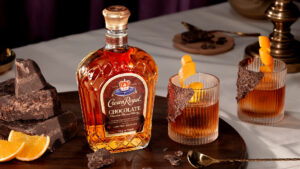
(Photo: Crown Royal)
Verdict: Probably Safe
The undisputed king of all things Canadian alcohol, Crown Royal is the first (and perhaps last) brand most people think of when they imagine spirits north of the border. The blended and flavored whisky juggernaut accounts for a staggering 35% of the total global market share for Canadian whisky, moving between 7 million and 8 million cases per year and generating hundreds of millions in revenue for parent company Diageo.
Here’s where things get interesting. Though the whisky is mashed, aged and distilled at its main facility in Gimli, Manitoba, the company moved its US bottling operations to the United States in early 2026 to cut export costs. This means that Crown Royal ships its whisky in large quantities across the border before bottling locally at a handful of unnamed Diageo-owned facilities.
The Canadian alcohol ban appears to include an apparent omission in the annex’s listed Harmonized Tariff Schedule classifications. The annex specifically includes most non-rye Canadian whisky in containers of 4 liters or less, but does not list the HTSUS classification for other whisky in containers larger than 4 liters. That omission appears to leave bulk shipments of Canadian whisky outside the annex’s listed classifications, though the U.S. Customs and Border Protection would ultimately determine how individual imports are classified.
If that turns out to be the case, it indicates the American government has created a lucrative workaround for brands that bulk import Canadian whisky, among them heavy hitters like WhistlePig, Pendleton and Black Velvet. We’ll have a better idea of what these exemptions mean in the weeks and days leading up to the ban. In the meantime… better safe than sorry to stock up on your favorite Crown Royal whisky flavor.
Crystal Head Vodka
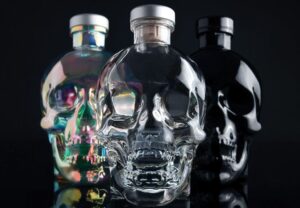
(Photo: Crystal Head)
Verdict: Banned
Founded in 2008 by “SNL” and “Ghostbusters” alum Dan Aykroyd, Crystal Head is a quadruple-distilled vodka produced in Newfoundland, Canada, that makes use of Ontario-grown corn and Newfoundland-sourced water. So the story goes, the brand’s iconic bottle was inspired by Aykroyd’s fascination with the legend of the thirteen skulls — the very same that inspired the fourth installment in the “Indiana Jones” franchise.
Sadly for the comedian-turned-entrepreneur, Crystal Head is one of the first brands that will be decapitated by the Canadian alcohol ban. Standard packaged Canadian vodka appears to fall squarely within the annex, while bulk vodka could raise a different classification question because the annex distinguishes between containers of 4 liters or less and larger packaged containers.
Labatt Beer
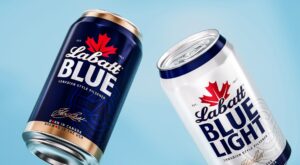
(Photo: Labatt)
Verdict: Safe
Labatt is to Canadian beer what Crown Royal is to Canadian whisky. Founded in 1847 by an Irish immigrant with next to no prior brewing experience, Labatt is now the largest brewer in Canada — and its flagship Labatt Blue, the best-selling Canadian beer worldwide.
Much like Crown Royal, however, the technicalities of Labatt’s ownership structure have rendered some parts of its production less Canadian than others. In 2009, brewing titan Anheuser-Busch InBev was forced to sell off the rights and business for Labatt USA following scrutiny from American antitrust officials. The version of Labatt Blue widely available in the U.S. has thereafter been produced at the Genesee Brewery in Rochester, New York, where each of its cans is labeled with the bottom text “Born in Canada, Brewed in the USA.” Look close enough, and you’ll notice this version of the beer isn’t technically a Canadian Pilsner, but a Canadian-style pilsner.
Don’t let the maple leaf logo fool you — Labatt sold in the US of A is as American as Jack Daniel’s and Freedom fries. Tariffs need not apply.
Other beers won’t be quite as lucky if and when the ban takes effect. The annex takes aim at all Canadian-origin packaged beers made from malt, casting a wide net that will affect historic independent brands like Moosehead Lager and Steam Whistle Pilsner.
Empress 1908

(Photo: Empress 1908)
Verdict: Banned
Empress 1908 is a popular gin brand produced by Victoria Distillers in British Columbia, Canada. The imprint is best known for its flagship Indigo Gin, a distinctly floral, purple-hued spirit that naturally shifts to shades of lavender, pink or fuchsia depending on the mixer. If bright colors aren’t to your liking, we’d also recommend its regular ol’ Original Gin, which pops with an earthy mix of peppercorn, dill, green apple and sarsaparilla on the palate.
Whether or not they contain added colors or flavoring, all forms of Canadian-origin packaged gin are slated to be banned by the end of the month.
Canadian Club, Canadian Mist and All Else Canadian Whisky

(Photo: Canadian Club)
Verdict: Banned
Any Canadian whisky not bottled in the United States is shaping up to get banned under the Trump administration’s latest tariff scuff. Alas, Canada is a country rich in distillation heritage, laying claim to dozens of major whisky distillers and hundreds of craft labels dotted across the country. With the exception of Crown Royal and Black Velvet, it looks like all of them are about to get the boot.
Prominent names include Canadian Club, a Suntory-owned brand produced in Windsor, Ontario; the Sazerac-owned Canadian Mist; Pernod Ricard’s Lot No. 40; Forty Creek; Alberta Premium; and JP Wiser’s. Some of these brands are owned by international conglomerates that have the means to outsource bottling to the United States. If the Crown Royal business model can turn a profit for parent company Diageo, then we may soon see its competitors copy the same workaround.
Dillon’s Small Batch Distillers

(Photo: Dillon’s)
Verdict: Banned, Banned, Banned
Dillon’s is an up-and-coming Ontario-based distillery that had the enormous fortune of being acquired by Mark Anthony Group — the very same behind White Claw — in 2021. Just about everything that Dillon’s specializes in is expressly mentioned in the ban. Vodka is a no-go, gin is kaput and bitters “fit for use as beverages” are dead in the water.
Ready-to-drink cocktails, the biggest part of the distiller’s business, are not mentioned by name in the annex. Given the size and scale of today’s pre-mixed cocktail market, this feels like a notable omission.
The annex does not specifically name ready-to-drink cocktails, but that does not necessarily exclude them. Dillon’s canned gin and vodka cocktails could fall under one of the annex’s broader alcohol classifications depending on their customs classification.